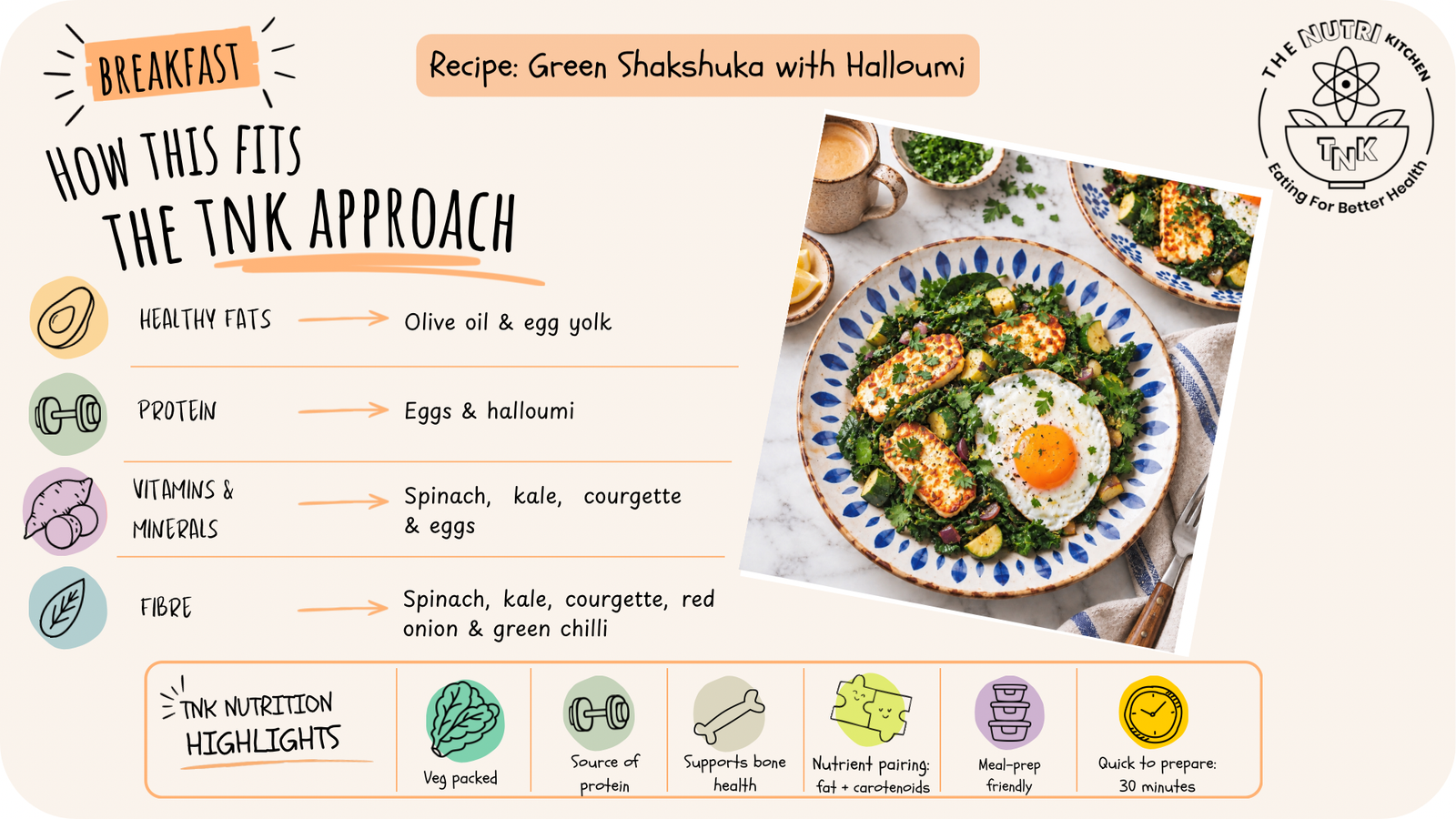
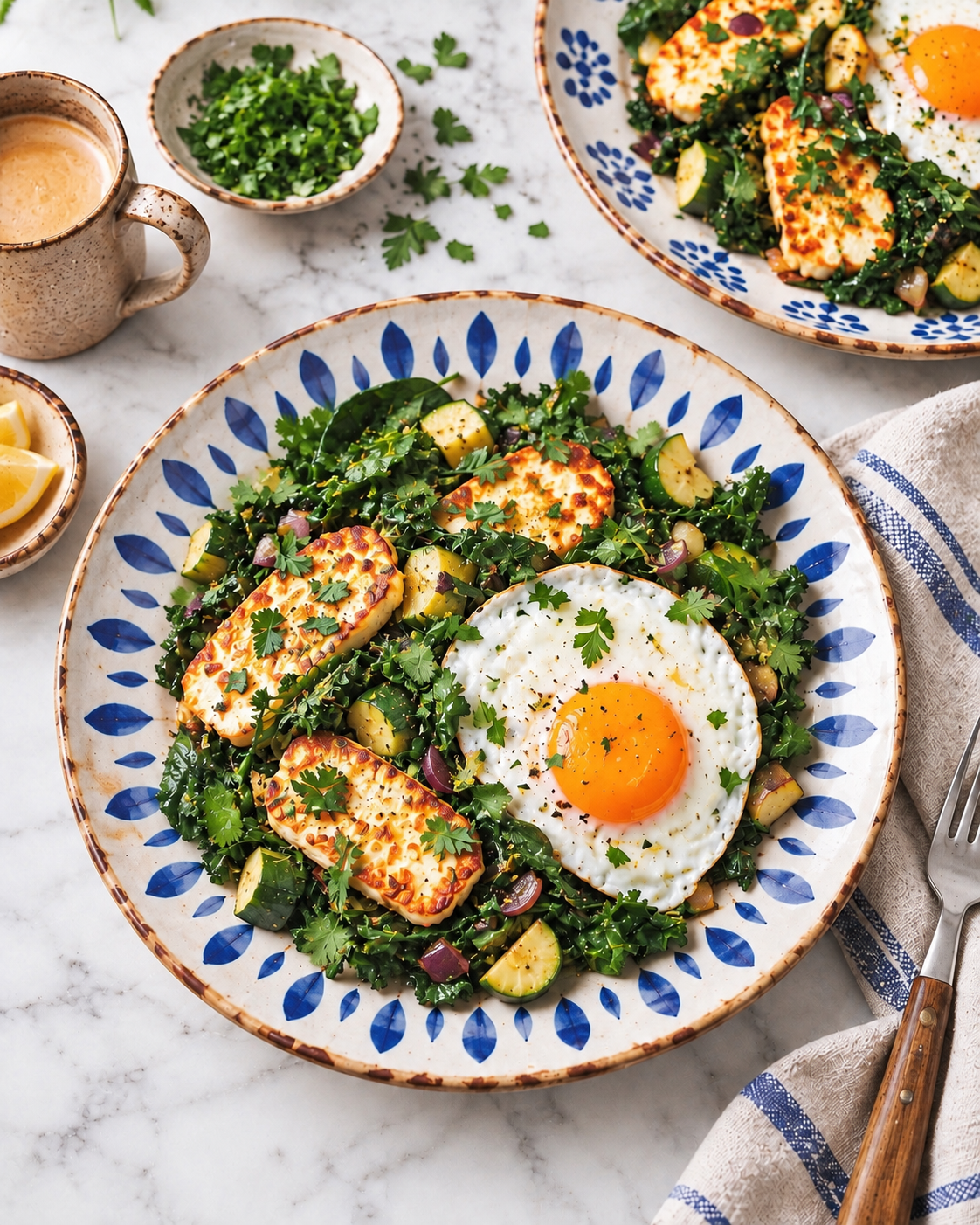
Shakshuka is traditionally associated with eggs cooked in a rich tomato and pepper sauce. This green version takes things in a different direction. Courgette, spinach and kale are cooked down with some veggies, then served with golden halloumi, a fried egg, plus herbs.
The NHS recommends at least five portions of a variety of fruit and vegetables each day. With one adult portion generally equivalent to around 80g. The portion guidance also gives some useful food-specific examples: including half a large courgette, one medium onion, two heaped tablespoons of cooked spinach or four heaped tablespoons of cooked kale as approximately one portion.
Using those guidelines, the 100g spinach and 100g kale in this recipe contribute around 2½ portions between them. A large courgette contributes roughly another two portions and the onion approximately one more. That means the vegetable base provides around 5½ portions across the four-serving recipe, or approximately 1.4 portions per serving! Even before counting the smaller amounts of chilli, garlic or herbs. A perfect showcase of how veggies do not have to be saved just for lunch and dinner.
There is also some interesting research behind the choice of leafy greens. Spinach is naturally rich in dietary nitrate. Which is converted in the body through the nitrate, nitrite and nitric oxide pathway. Nitric oxide has several physiological roles, including helping regulate blood vessel tone and blood flow. A systematic review of 29 human studies found that dietary nitrate appeared to improve measures of macrovascular function. Although findings for the smaller blood vessels were less consistent.
In a randomised controlled crossover trial involving 27 healthy adults, participants consumed either a high-nitrate spinach soup or a low-nitrate control soup for 7 days. Researchers observed modest reductions in some blood pressure measurements and changes in arterial function following the spinach intervention. This does not mean that eating spinach treats high blood pressure. But it provides an interesting example of one mechanism through which nitrate-rich vegetables may contribute to the benefits.
The way these vegetables are eaten may matter too. Green vegetables contain carotenoids, which are fat-soluble compounds, so the presence of dietary fat can influence their absorption. Kim & colleagues studied 16 participants. Who ate the same carotenoid-rich vegetable salad with either no egg, 1.5 eggs or three whole eggs. Carotenoid absorption was substantially greater when the higher amount of whole egg was eaten alongside the vegetables.
The researchers studied a raw salad rather than cooked shakshuka, so the findings cannot be transferred directly to this recipe. However, it is a useful reminder that we eat meals rather than isolated nutrients. Here, vegetables are paired naturally with egg, halloumi and olive oil, creating a breakfast combining plenty of greens with protein, fat and, importantly, flavour.
Why this recipe works
➡️ Spinach and kale bring folate, vitamin K and carotenoids. The 200g of leafy greens used across the recipe provides more than just bulk. Folate is involved in normal cell division and red blood cell formation. Vitamin K contributes to normal blood clotting and bone health. The greens also contain carotenoids such as lutein and beta-carotene. This links nicely with the research above on why pairing vegetables with some dietary fat can be useful.
➡️ Eggs provide protein as well as choline. Eggs help give this vegetable-heavy breakfast more substance, but choline is an interesting nutrient that often gets less attention. It is needed for normal cell membranes and is involved in producing acetylcholine, a neurotransmitter used by the nervous system. The yolk is particularly important here, as this is where much of the egg’s choline and fat-soluble nutrients are found.
➡️ Halloumi contributes protein and calcium. Calcium is well known for its role in maintaining bones and teeth. But it is also needed for normal muscle function and nerve signalling. Halloumi is relatively salty. That’s why using a few golden slices alongside a much larger portion of vegetables is better. It provides the flavour and texture without needing to dominate the plate.
➡️ Olive oil provides unsaturated fats. These fats help make the meal more satisfying and also help with the absorption of fat-soluble compounds from the vegetables. The carotenoids found in spinach and kale, fat in the olive oil and egg yolk has a practical nutritional role! Plus adding flavour.
➡️ The base is relatively low in carbohydrate: That is not automatically a benefit or a drawback. It simply means you can adapt the meal depending on what your morning looks like. For additional energy, particularly before or after exercise, serving it with wholegrain toast adds carbs and fibre.
Ingredients
Equipment
Method
- Heat 2 tbsp of the olive oil in a large frying pan over a medium heat. Add the red onion and cook for around 5 minutes until beginning to soften.
- Stir in the garlic, season with a little salt and pepper, then cover and cook over a low heat for another 5 minutes.
- Add 1 tbsp olive oil, followed by the courgette and green chilli. Increase the heat to medium and cook uncovered for around 5 minutes, stirring occasionally, until the courgette starts to soften.
- Stir through the cumin, spinach and kale. Continue cooking until the leafy vegetables have wilted and the mixture is soft and well combined. Transfer the green shakshuka mixture to a bowl and keep warm.
- Wipe out the frying pan and add another 1 tbsp olive oil. Fry the halloumi until golden on both sides, then remove from the pan and keep warm.
- Add the remaining olive oil if needed and fry the eggs until the whites are cooked but the yolks are still soft.
- Divide the green shakshuka between 4 plates. Top each portion with 3 slices of halloumi and a fried egg, then finish with chopped parsley and black pepper.