You do everything right.
You take your multivitamin every morning. You’ve added vitamin D because everyone says we’re all deficient in the UK. Maybe magnesium for sleep. B12 for energy. Omega-3 because it’s supposed to be good for your brain.
You’re spending £30, £40, maybe £50 a month on supplements.
And you still feel exactly the same.
Still tired by 3pm. Still struggling to concentrate. Still wondering if you’re missing something.
Here’s the truth: you probably are missing something. But it’s not another supplement.
This is Part 3 of The Supplement Series. In Part 1, we looked at whether supplements are actually worth the money. In Part 2, we unpacked why so many people take them “just in case” even when they don’t need them.
Now we’re asking the bigger question: can a multivitamin do the same job as real food?
The answer is no. But understanding why might finally explain what’s been going wrong.
The problem with the “insurance policy” approach
Most people treat multivitamins like nutritional insurance. The logic makes sense: if you’re not eating perfectly, a multivitamin fills the gaps.
One tablet. 100% of your daily vitamins and minerals. Problem solved. Except your body doesn’t work in neat percentages. So a multivitamin/supplement can’t replicate what real food actually does.
What actually happens when you swallow a multivitamin
Let’s walk through what your body does with that tablet.
1. Absorption is not guaranteed
Your gut can only absorb nutrients in specific forms. Some supplement ingredients are highly bioavailable—your body uses them efficiently. Others are cheap filler forms that your gut struggles to process.
For example:
- Magnesium oxide (commonly used in cheap multivitamins) has poor absorption and often causes digestive upset
- Magnesium glycinate is far more bioavailable and gentle on your stomach
The label says “100% of your RNI for magnesium.” But if it’s in the wrong form, you might only absorb 20%.
2. Your body discards what it doesn’t need
If your nutrient stores are already adequate, your body can’t use the excess.
Water-soluble vitamins (B vitamins, vitamin C) leave through your urine. You’ve probably noticed bright yellow pee after taking a multivitamin—that’s riboflavin (B2) being flushed out.
Fat-soluble vitamins (A, D, E, K) get stored in your liver and body fat. Over time, excessive intake can lead to build-up, especially with vitamins A and D.
Your body is efficient. It takes what it needs and discards or stores the rest. A multivitamin doesn’t change that.
3. Tablets don’t contain the supporting compounds food does
For example: when you eat an orange, you don’t just get vitamin C. You get:
- Fibre (slows sugar absorption, feeds your gut bacteria)
- Flavonoids (support the vitamin C and have their own anti-inflammatory effects)
- Natural enzymes (aid digestion)
- Water (keeps you hydrated)
A vitamin C tablet gives you ascorbic acid. That’s it.
Food delivers nutrients in a complex matrix. Your body evolved to process food, not isolated compounds in tablet form.
4. Supplements don’t replace the act of eating
This sounds obvious, but it matters.
Real food:
- Regulates blood sugar (especially when it contains protein, fat, and fibre)
- Supports your microbiome (the trillions of bacteria in your gut that influence everything from mood to immunity)
- Provides satiety (the feeling of fullness that stops you from overeating)
- Delivers energy in a form your body can use steadily throughout the day
A multivitamin provides none of this.
So, how much do you actually need? Your essential vitamins and minerals
Before we go further, it helps to understand what your body needs and why these nutrients behave differently.
Nutrients fall into categories, and each one is processed differently by your body:
Fat-soluble vitamins (A, D, E, K): Stored in your body’s fat and liver. Because they accumulate, taking too much over time can lead to toxicity.
Water-soluble vitamins (B vitamins, vitamin C): Not stored. Excess is removed through urine. You need a steady supply from food.
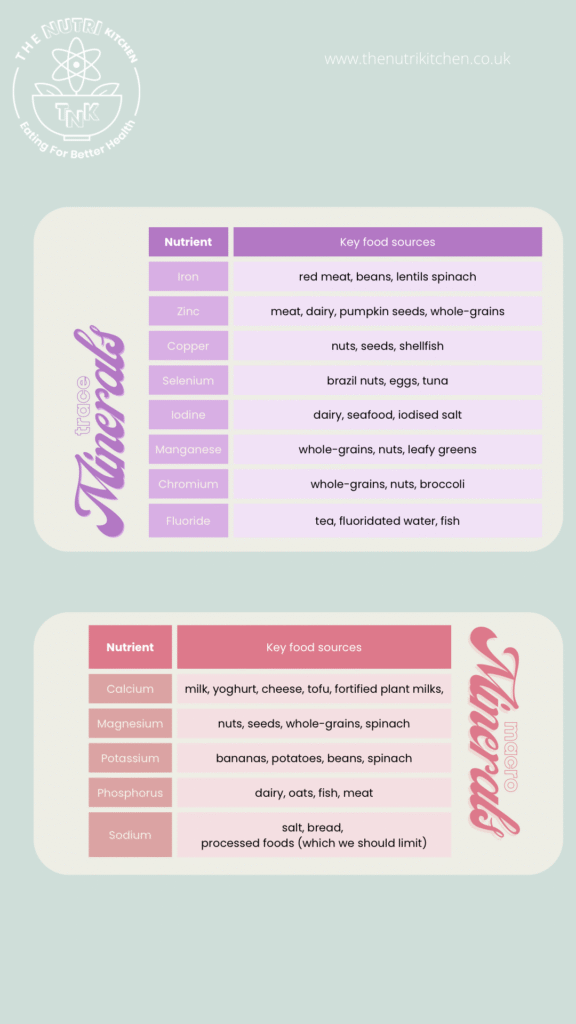
Macrominerals (calcium, magnesium, potassium): Needed in larger amounts. Essential for bones, muscles, nerves, and fluid balance.
Trace minerals (iron, zinc, selenium, iodine): Needed in tiny amounts. Critical for immunity, energy, thyroid function, and more.
Understanding these groups explains why a multivitamin doesn’t behave the same way food does.

What the research actually says
Large, well-designed studies consistently show that multivitamins do not improve health outcomes for people who are already eating reasonably well.
➡️ Loftfield and colleagues (2024) followed more than 390,000 adults across three major US cohorts. They found no link between daily multivitamin use and lower risk of death from any cause.
➡️ Bleske et al. (2020) found that people taking supplements often felt healthier—but their actual clinical outcomes were no different from those who didn’t take supplements.
➡️ Merwid-Lad and colleagues (2022) found that most people take supplements based on perceived benefit, not confirmed deficiency.
Here’s what this means: multivitamins aren’t harmful, but they don’t replace food or provide extra benefit if your nutrient levels are already adequate.
So when do supplements actually help?
There are legitimate reasons to take supplements. But they’re more specific than “just in case.”
Supplements are useful when:
- You have a diagnosed deficiency (confirmed by blood tests, not a hunch)
- You’re pregnant or planning to be (folic acid is critical in early pregnancy)
- You follow a vegan or restricted diet (B12, iron, and omega-3 may need supplementing)
- You have a medical condition that affects nutrient absorption (e.g., Crohn’s disease, coeliac disease)
- You’re recovering from illness or have a very low appetite
In the UK, the NHS recommends vitamin D supplementation for everyone during autumn and winter (October to March), as we don’t get enough sunlight to produce it naturally.
But these are targeted interventions. Not “one multivitamin fits all.”
The real question: why are you still tired?
If you’re taking a multivitamin and still feeling exhausted, it’s worth asking:
Is it actually a nutrient deficiency – or is it something else?
Common causes of persistent tiredness include:
- Poor sleep quality (not just quantity)
- Blood sugar crashes from irregular eating or high-sugar meals
- Chronic stress (which depletes magnesium, B vitamins, and more)
- Underlying health issues like thyroid dysfunction or anaemia
- Gut health problems (even if you’re eating well, malabsorption can prevent nutrients from being used)
A multivitamin won’t fix any of these. But understanding your specific situation can.
What to do instead
Start with food. Your body is designed to extract nutrients from real, whole foods. Prioritize:
- Protein at every meal (supports blood sugar, energy, and repair)
- Colourful vegetables (provides antioxidants and phytonutrients)
- Healthy fats (needed for hormone production and fat-soluble vitamin absorption)
- Complex carbohydrates (steady energy, fibre for gut health)
Test, don’t guess. If you genuinely think you have a deficiency, get blood tests. Don’t supplement based on symptoms alone—many nutrient deficiencies cause overlapping symptoms (e.g., fatigue can be low iron, low B12, low vitamin D, or none of the above).
Work with someone who understands the full picture. Remember: nutrition isn’t just about vitamins and minerals. It’s about digestion, stress, sleep, blood sugar regulation, and how your body uses what you eat.
Here’s how TNK can help
If you’re stuck in the cycle of buying supplements, hoping they’ll work, and still feeling off- we can help you figure out what’s actually going on.
We work with people who are tired of guessing and ready to get answers.
Here’s a brief overview of what a free 30-minute discovery call will cover:
- Look at your current symptoms, diet, and supplement routine
- Identify what might actually be causing your fatigue, brain fog, or low energy
- Discuss whether testing would be useful (and what tests are actually worth doing)
- Create a clear next step—whether that’s working together or pointing you in the right direction

If you’re ready to stop wasting money on supplements that aren’t working and start getting real answers, book your call here: NOW